Best Smart Thermostats 2026: Research-Based Picks for Every Home
June 19, 2026
by Just Tech Me At
*As an Amazon Associate, I earn from qualifying purchases.*
Introduction
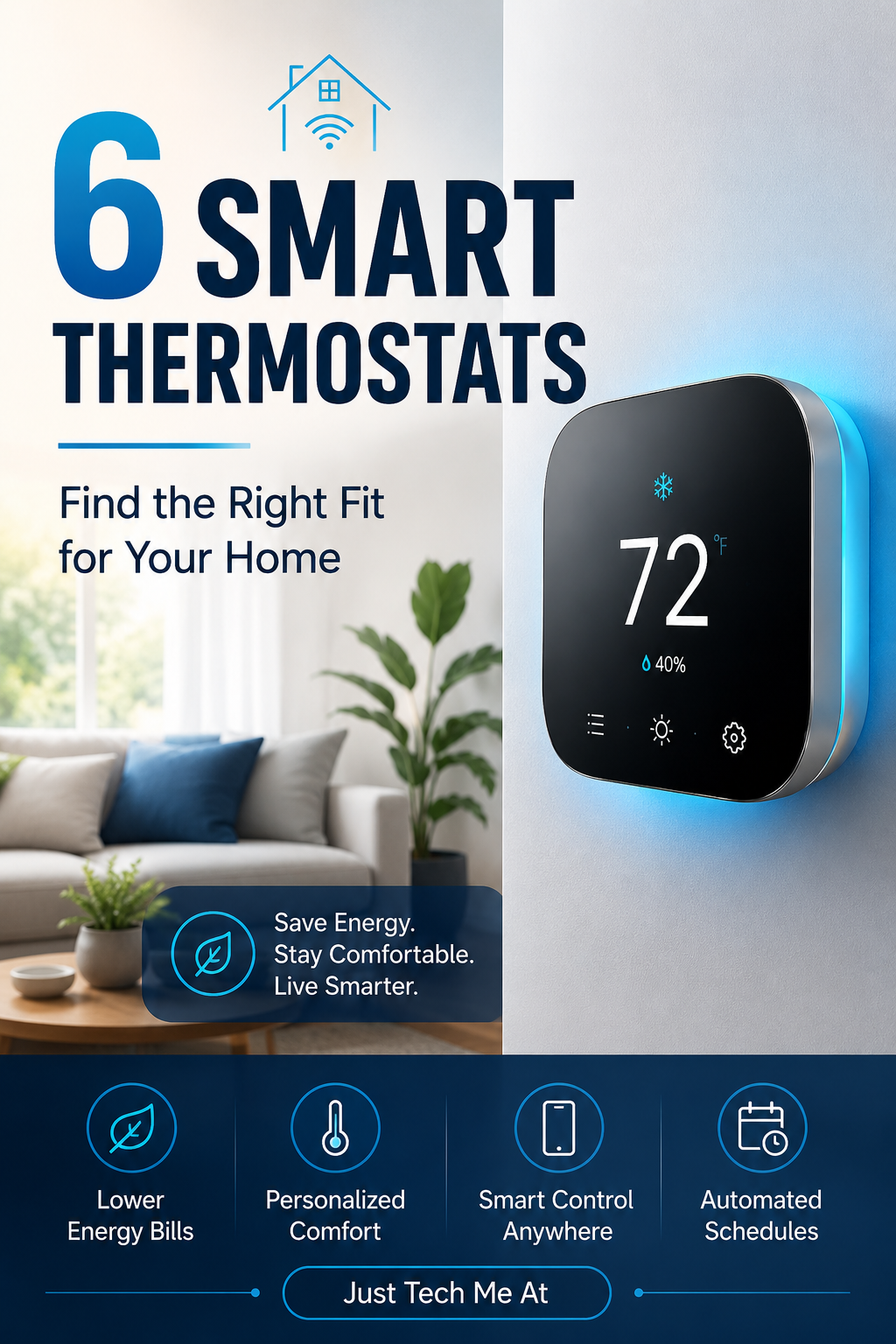
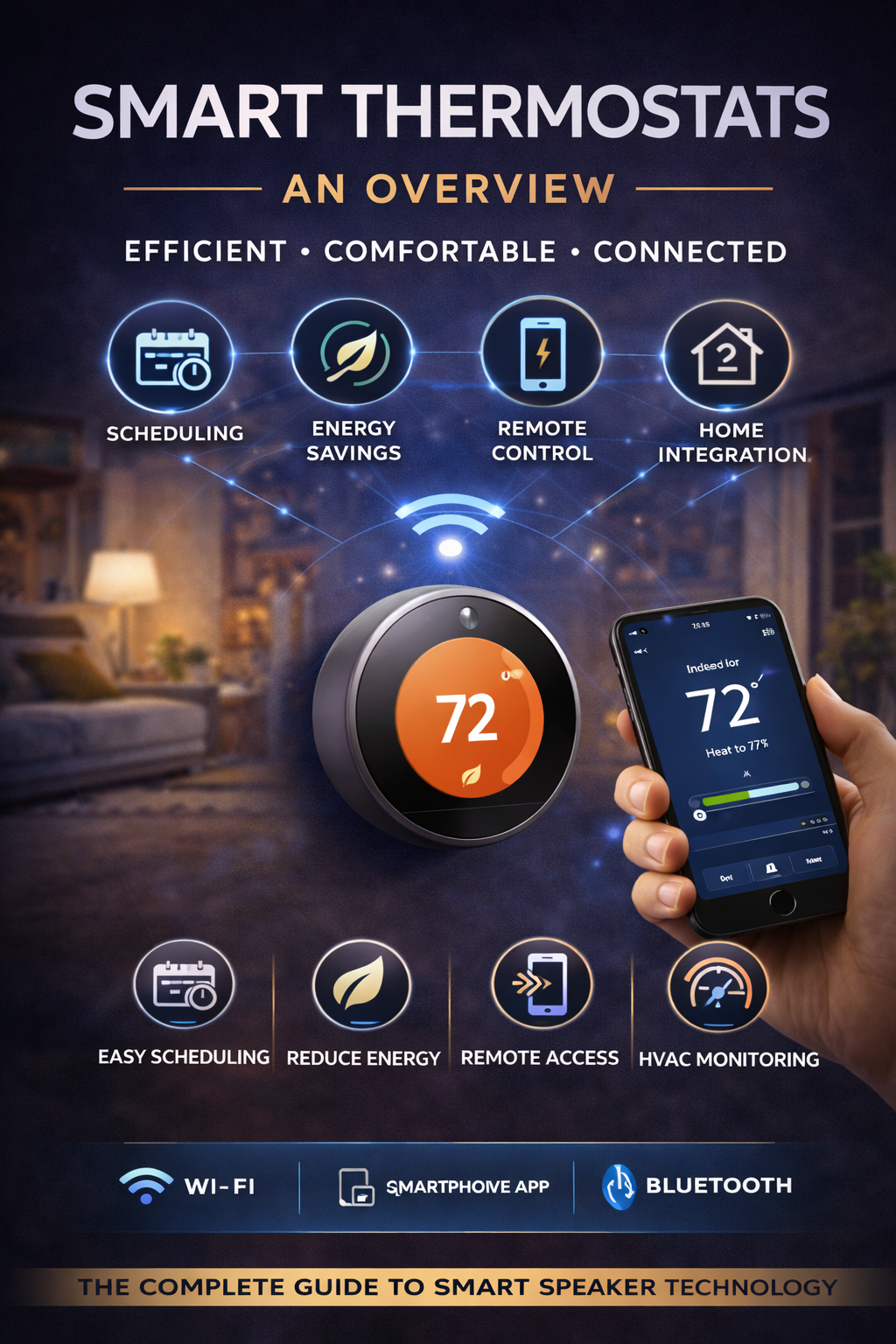
Smart thermostats in 2026 are more capable than ever, with improved automated scheduling, tighter voice-assistant integration, and broader compatibility with heat pumps and multi-stage systems.
This guide compares six widely available models and focuses on concrete strengths, limitations, HVAC compatibility, ecosystem support, room sensors, installation needs, and overall value.
Product note: Availability, model names, and specifications can change. Confirm the exact retail model, wiring requirements, and current product listing before purchasing.
Not sure which smart thermostat fits your HVAC system?
Compare system compatibility, C-wire requirements, room sensors, learning features, voice assistants, installation difficulty, and pricing before choosing.
The Google Nest Learning Thermostat builds and adapts a heating and cooling schedule based on household behavior. It combines a premium round design, energy reports, geofencing, Eco Temperatures, and integration with Google Home.
Key Features
Learning algorithm automatically builds and adapts heating and cooling schedules.
Farsight display can show temperature, time, or weather from across the room.
Works with many 24V HVAC systems, including numerous heat pumps and multi-stage systems.
Energy History and monthly Home Energy Reports provide usage insights.
Control through the Google Home app.
Voice control through Google Assistant and supported Alexa integrations.
Geofencing and Eco Temperatures can reduce energy use when the home is unoccupied.
Premium metallic finishes suit modern interiors.
<
✅ Pros
Excellent automatic scheduling with limited ongoing adjustment.
Attractive design with a bright, readable display.
Strong energy-management features and a mature ecosystem.
Broad compatibility with many residential HVAC systems.
Established app and smart-home integrations.
❌ Cons
Costs more than many competing thermostats.
Learning behavior may initially conflict with comfort preferences.
Room temperature sensors are sold separately.
Some systems require a C-wire or Nest Power Connector.
The generation and exact retail model must be reconfirmed before publication.
2. Amazon Smart Thermostat
Best for: Budget-minded Alexa households that want a simple but fully smart thermostat.
The Amazon Smart Thermostat, developed with Resideo, delivers core scheduling, remote control, energy insights, and Alexa automation at a lower price than many premium competitors.
Key Features
Minimalist capacitive touch interface.
Alexa voice control and Alexa Hunches for automatic adjustments.
ENERGY STAR certified with usage insights in the Alexa app.
Supports many common 24V heating and cooling systems.
Compatible with numerous heat-pump configurations.
Guided app-based installation and wiring assistance.
Optional C-wire adapter kit for systems without a common wire.
Remote control and scheduling through the Alexa app.
✅ Pros
One of the more affordable full smart thermostats.
Clean, unobtrusive design.
Strong experience for Alexa-centered homes.
Guided installation is approachable for many DIY users.
Provides the core benefits of app control and automation.
❌ Cons
Does not offer advanced learning comparable to Nest or Ecobee.
Does not natively support remote room sensors.
The best experience depends heavily on Alexa.
Wall controls are basic compared with premium touchscreen models.
Google Home and Apple Home support are limited.
3. Ecobee Smart Thermostat Enhanced
Best for: Data-driven users who want powerful scheduling, strong heat-pump support, and future-ready integrations.
The Ecobee Smart Thermostat Enhanced balances advanced HVAC support, detailed scheduling, energy-saving automation, and optional room sensors. It sits between Ecobee's entry and premium models.
Key Features
Supports advanced HVAC configurations, including multi-stage systems and many heat pumps.
Smart Recovery prepares the home to reach the scheduled temperature on time.
Ecobee energy-saving features adjust operation while protecting comfort.
Responsive touchscreen with straightforward on-device controls.
Detailed runtime information and scheduling through the Ecobee app.
Works with Ecobee SmartSensor for room temperature and occupancy control.
Compatible with Alexa, Google Assistant, and Apple Home.
Supports broad smart-home integration and automation.
✅ Pros
Excellent option for complex HVAC systems and heat pumps.
Granular scheduling and useful runtime insights.
Strong support across major smart-home platforms.
Optional room sensors improve comfort in occupied rooms.
Good balance between premium capability and price.
❌ Cons
Costs more than entry-level smart thermostats.
Room sensors increase the total cost.
Complex HVAC setups may require more installation work.
Some features require careful configuration.
Users seeking only basic remote control may find it excessive.
4. Sensi Touch 2 Smart Thermostat
Best for: Renters and DIYers who want broad compatibility and a clear touchscreen interface.
The Sensi Touch 2 emphasizes straightforward installation, visible wall controls, flexible scheduling, and broad smart-home compatibility without forcing users into one ecosystem.
Key Features
Full-color touchscreen with intuitive on-device controls.
Step-by-step app-based installation guide.
ENERGY STAR certified.
Flexible scheduling and remote access through the Sensi app.
Works with Alexa, Google Assistant, Apple Home, and supported SmartThings setups.
Broad compatibility with many residential HVAC systems.
Geofencing for location-based temperature adjustments.
Supports practical DIY installation for many households.
✅ Pros
User-friendly installation and setup.
Strong on-wall controls reduce dependence on the app.
Broad ecosystem compatibility.
Often provides good value when discounted.
Practical choice for users who prefer traditional controls.
❌ Cons
Offers fewer learning features than Nest or Ecobee.
Design is more functional than premium.
Reporting and analytics are more basic than leading competitors.
C-wire requirements vary by system and package.
Advanced multi-zone configurations may still need professional guidance.
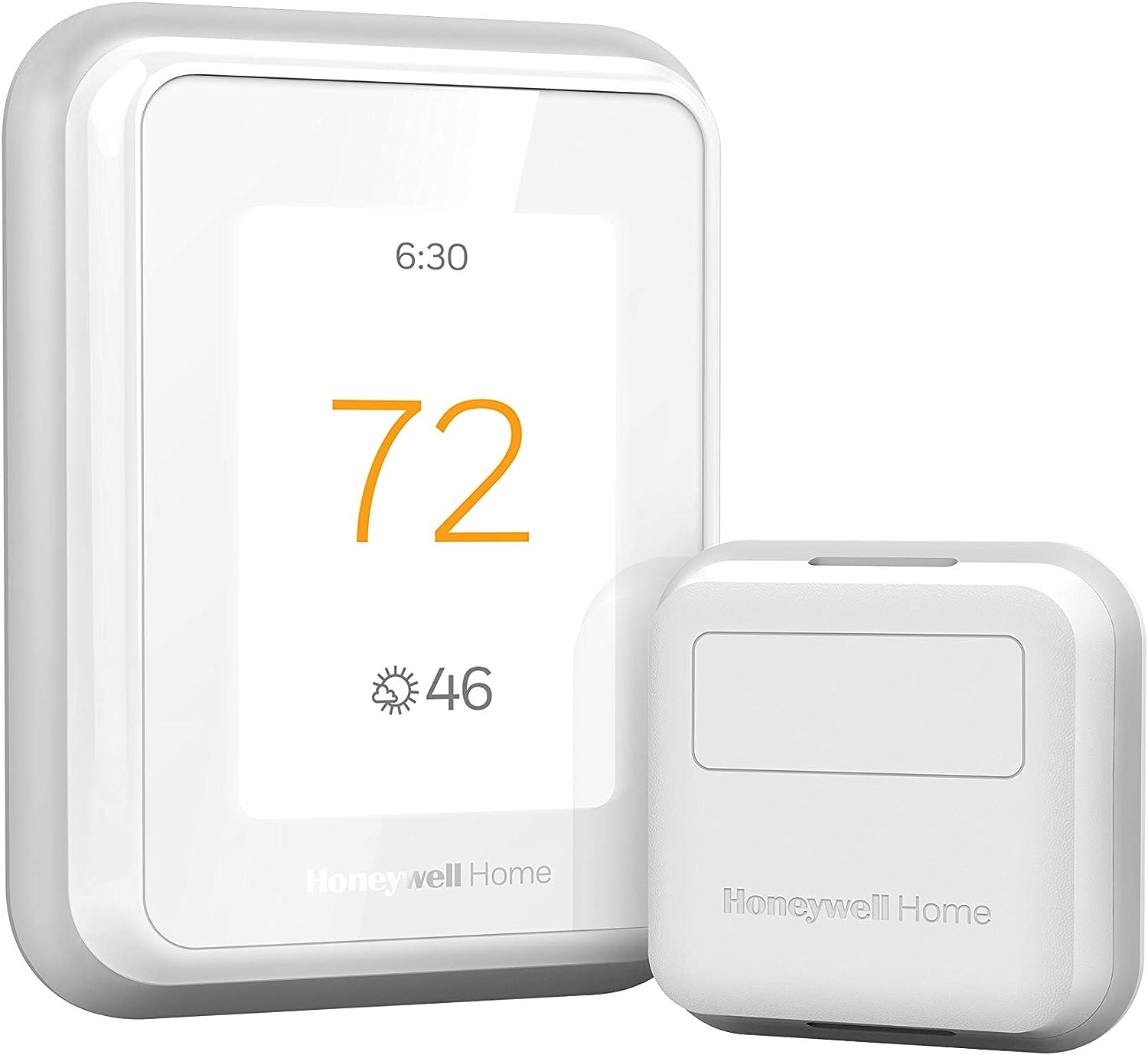
5. Honeywell Home T9 Smart Thermostat with Smart Room Sensor
Best for: Whole-home comfort using remote sensors and occupancy detection.
The Honeywell Home T9 uses room sensors to measure temperature and occupancy, allowing households to prioritize specific rooms or average conditions across multiple areas.
Key Features
Includes a Smart Room Sensor in many retail packages.
Long-range sensor communication.
Prioritizes selected rooms or averages multiple sensors.
Occupancy detection helps focus comfort on rooms in use.
Works with Alexa and Google Assistant.
Remote control through the Resideo or Honeywell Home app.
Geofencing and scheduling support.
Compatible with many forced-air, hydronic, and heat-pump systems.
✅ Pros
Room sensor is included in many packages.
Occupancy detection can reduce conditioning of unused rooms.
Supports a wide variety of HVAC systems.
Reliable remote access through a mature platform.
Good option for multi-level homes and uneven temperatures.
❌ Cons
Design is less premium than Nest or Ecobee.
Energy analytics are less advanced than Ecobee's.
The best experience may require additional sensors.
Adding several sensors increases the total cost.
Compatibility must be confirmed for the exact wiring configuration.
6. Honeywell Home RTH8800WF T5 Smart Thermostat
Best for: Homeowners who want Honeywell reliability at a lower price with simple touchscreen controls.
Energy reports are less advanced than Nest or Ecobee.
Offers fewer learning and automation features.
Compatibility still depends on exact HVAC wiring.
How to Choose the Right Smart Thermostat in 2026
Check system compatibility: Confirm whether your HVAC system is conventional or a heat pump, single-stage or multi-stage, and whether it has a C-wire.
Choose your ecosystem: Amazon works best in Alexa-centered homes; Nest is a natural fit for Google Home; Ecobee and many Sensi models support Apple Home.
Decide between learning and manual control: Nest and Ecobee emphasize automation, while Sensi and Honeywell provide more traditional schedules and remote access.
Consider remote sensors: Ecobee SmartSensor and Honeywell T9 sensors can improve comfort in homes with hot spots, cold rooms, or multiple levels.
Compare installation requirements: Some systems may need a C-wire adapter, power connector, or professional installation.
Set a realistic budget: Amazon Smart Thermostat and Honeywell T5 often cost less, while premium Nest, Ecobee, and sensor-based systems offer more automation.
Product, Compatibility, and Energy-Savings Disclaimer
Smart thermostat compatibility depends on the exact HVAC system, wiring, voltage, regional app support, and available integrations. Energy savings vary by home, climate, schedule, equipment, and user behavior. Always use the manufacturer compatibility checker and consult a qualified HVAC professional when uncertain.
Bottom Line
The best smart thermostat depends on your HVAC system, preferred voice assistant, desired level of automation, need for room sensors, and budget. Nest and Ecobee provide stronger automation, Amazon offers affordable Alexa-first control, Sensi emphasizes simple installation, and Honeywell models provide practical scheduling and sensor options.



.svg.png)