Just Tech Me At
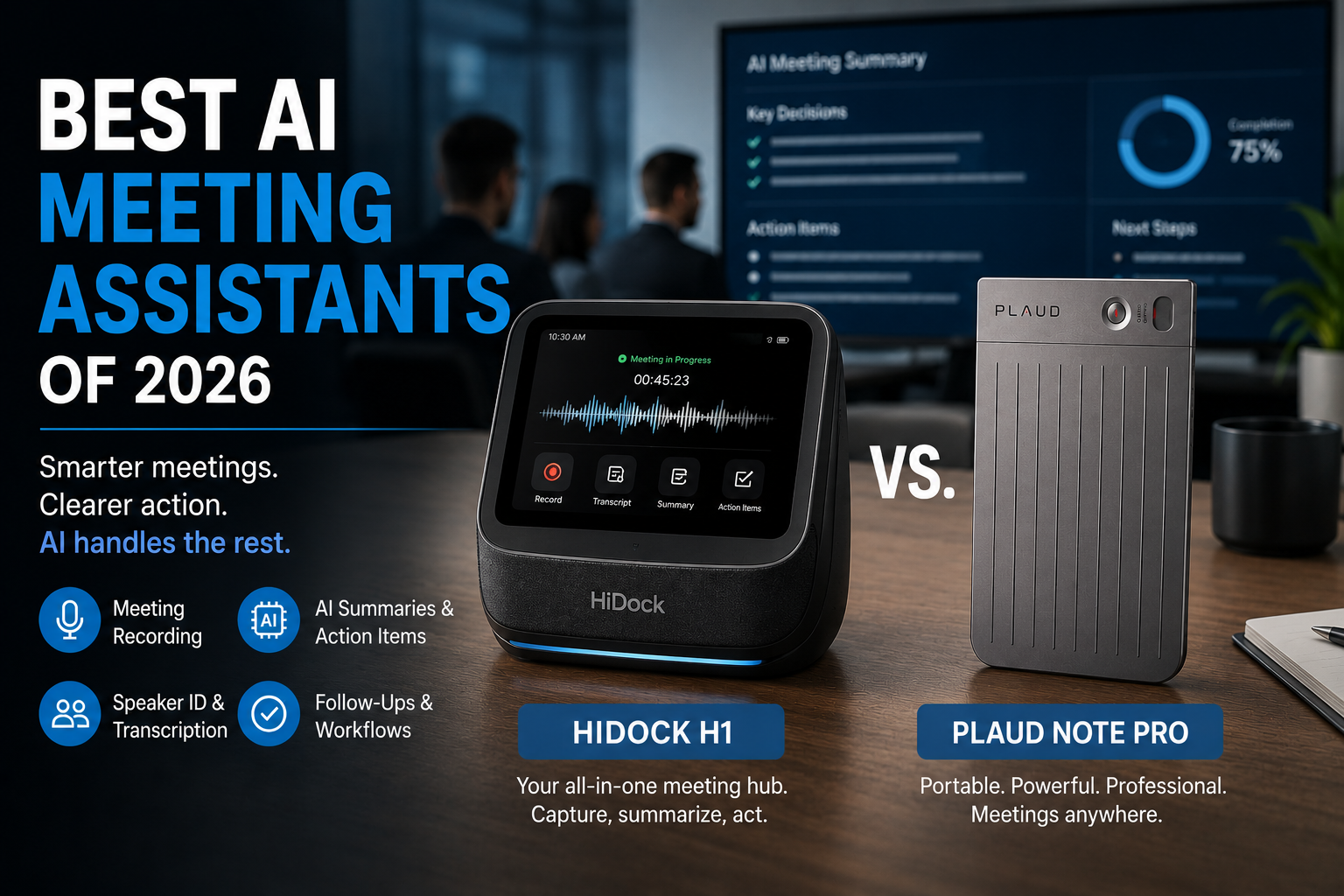
Stop Drowning in Meeting Notes:
HiDock H1 vs. Plaud Note Pro
Best AI Meeting Assistant for 2026?
September 5, 2026
by Just Tech Me At
*As an Amazon Associate, I earn from qualifying purchases.*



.svg.png)

Introduction:
Transforming Team Collaboration
The problem with meetings isn't always taking notes. It's everything that happens because of the meeting. Important decisions get buried in conversations, action items are forgotten, follow-up emails have to be written, and someone eventually has to turn a 45-minute discussion into a useful summary that the rest of the team can actually act on.
That's where AI meeting assistants move beyond the traditional idea of an AI note taker. An AI note taker primarily helps you capture and remember what was said. An AI meeting assistant takes the next step by helping turn the meeting itself into structured, actionable information—such as summaries, decisions, action items, responsibilities, and follow-up information.
The distinction matters because the two categories can look remarkably similar on the surface. Both can record audio, transcribe conversations, identify speakers, and generate AI summaries. The difference is the purpose of the workflow. A note taker is primarily a personal memory and information-capture tool. A meeting assistant is designed around the larger process of turning a meeting into something useful after the conversation ends.
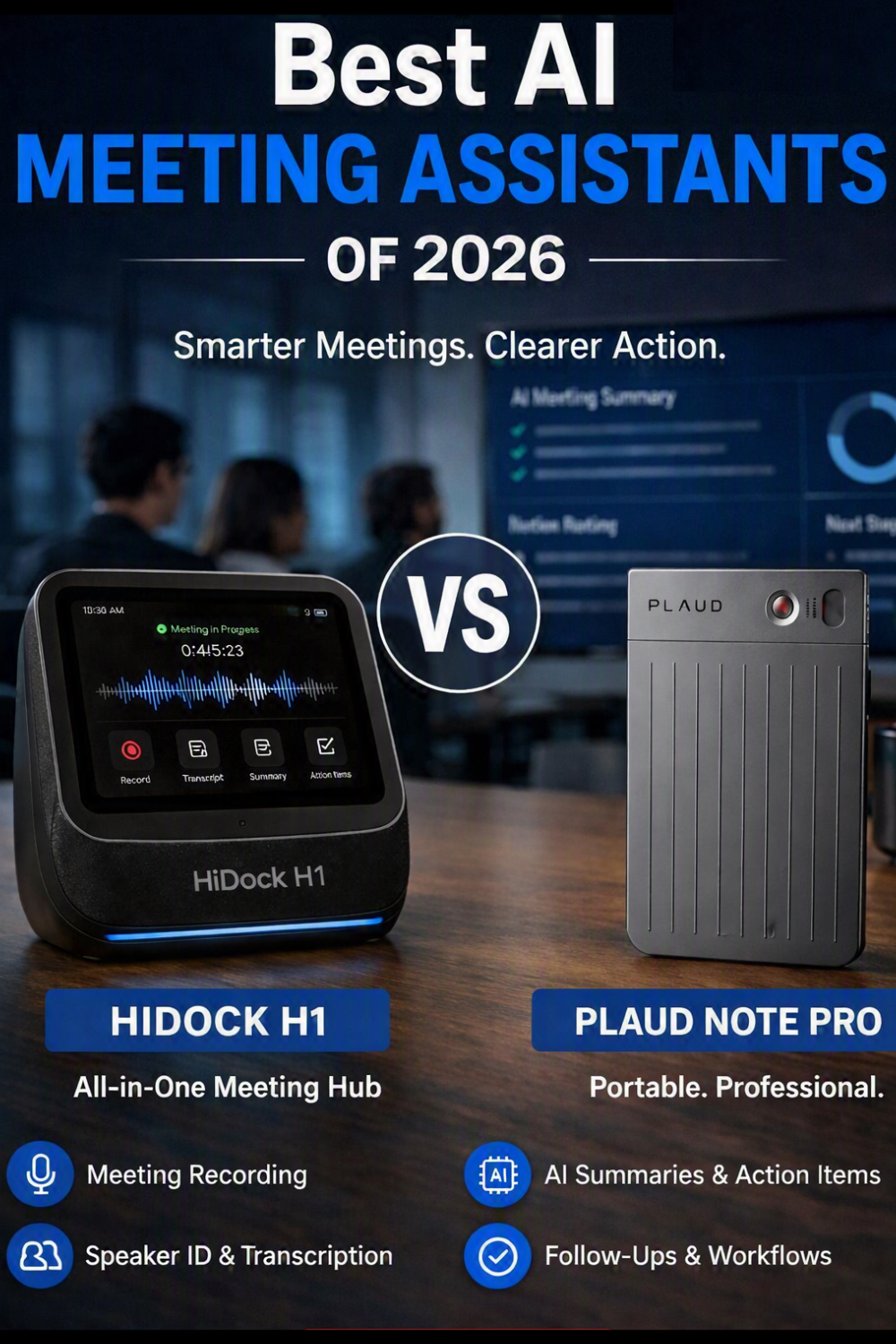
The HiDock H1 and Plaud Note Pro sit at the intersection of these categories, making them particularly interesting to compare. Both can capture meetings and use AI to process the resulting audio, but the H1 is designed more explicitly around the desk-based meeting and communications experience, while the Note Pro combines meeting capabilities with the flexibility of a portable AI recorder that can also be used for calls, interviews, and conversations outside the office.
In this comparison, we'll look beyond basic recording and transcription. We'll examine how each device fits into the complete meeting workflow, including meeting capture, phone and online calls, transcription, speaker identification, summaries, action items, portability, hardware, and overall productivity. The goal is to determine which device is better for people who don't simply want a recording of a meeting—they want less work to do after the meeting is over.
1. HiDock H1

HiDock H1 Overview
The HiDock H1 is an AI-powered meeting assistant designed to capture discussions, transcribe conversations, and automatically extract decisions, tasks, and follow-up items. With built-in noise reduction, multi-language support, and real-time summarization, it helps teams stay organized and improves meeting accountability. Its integrated speaker and microphone system make it ideal for conference rooms and hybrid work setups.
Key Features
✅ Pros
❌ Cons
2. Plaud Note Pro

Plaud Note Pro Overview
The Plaud Note Pro is a compact AI meeting assistant built for mobile professionals who need accurate transcription and structured meeting notes on the go. It captures conversations with dual-mic noise reduction and uses advanced language models to generate summaries, decisions, and action items. Its lightweight design and one-tap recording make it ideal for interviews, client meetings, and travel-friendly documentation.
Key Features
✅ Pros
❌ Cons
Disclaimer
Electronic devices, computers, and smart home products should be installed, configured, and used according to the manufacturer’s instructions. Features, compatibility, software updates, and app functions may change over time. Always review the latest product details on the retailer’s page before purchasing, and follow all safety guidelines provided by the manufacturer.
Final Thoughts
An AI meeting assistant should do more than save a recording. Its real value comes from reducing the administrative work that surrounds meetings. When a conversation can be automatically transformed into a transcript, summary, decisions, and action items, you spend less time reconstructing what happened and more time acting on it.
The HiDock H1 and Plaud Note Pro both offer capabilities that can make meetings easier to manage, but they approach the experience from different directions. The HiDock H1 is particularly compelling for users who spend much of their working day at a desk and want a meeting and communications device integrated into that environment. The Plaud Note Pro provides a more portable approach, making it useful not only for meetings but also for phone calls, interviews, and conversations away from the desk.
This is also where an AI meeting assistant differs from a conventional AI note taker. If you simply need a reliable way to capture conversations and turn them into notes, an AI note taker may be enough. But if your frustration comes from the entire meeting lifecycle—capturing the discussion, understanding what was decided, identifying what needs to happen next, and keeping track of follow-ups—an AI meeting assistant offers a broader solution.
Ultimately, the best choice depends on where your biggest productivity problem lies. If you're trying to remember conversations, look at AI note takers. If you're trying to turn meetings into organized work and actionable outcomes, that's where an AI meeting assistant can provide considerably more value.
Related Articles

















Browse Amazon
Shop Now!
*As an Amazon Associate I earn from qualifying purchases.*
More Smart Devices*As an Amazon Associate I earn from qualifying purchases.*
